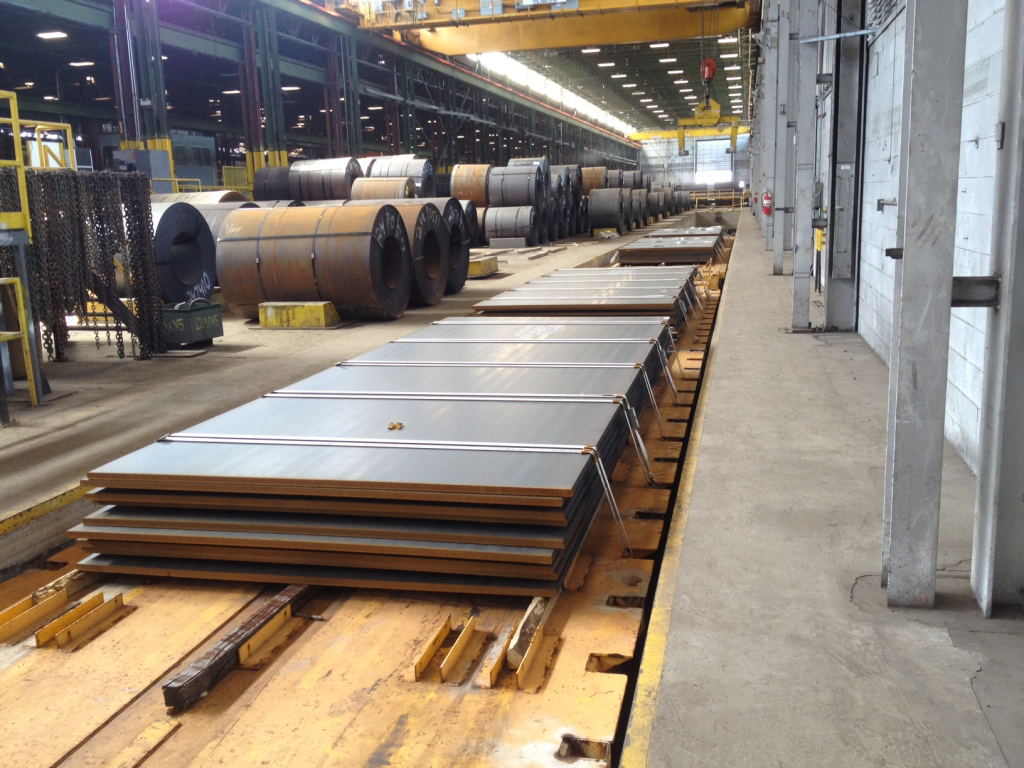
A36 steel plate is a low-carbon structural steel conforming to the American Society for Testing and Materials (ASTM) standard ASTM A36/A36M-03a. It belongs to the American standard for carbon steel plates, and its common domestic equivalent is Q235B (GB/T 700-2006 standard). Its chemical composition prioritizes low carbon (C≤0.25%), strictly controlling impurity elements (P≤0.04%, S≤0.05%), and adding elements such as silicon (Si≤0.40%) and manganese (Mn 0.80%-1.20%). Some specifications contain copper (Cu≥0.20%), ensuring good machinability and weldability.
In terms of core properties, A36 steel plate possesses a balanced strength, toughness, and weldability. With a yield strength of not less than 250 MPa (up to 360 MPa in some hot-rolled states), tensile strength of 400-550 MPa, elongation after fracture of not less than 20%, and excellent low-temperature impact toughness (impact energy ≥27 J at -20℃), it is suitable for environments with large temperature variations. This steel plate is easily processed by arc welding and gas welding, but it is prone to rusting in air, requiring surface treatments such as shot blasting, painting, or galvanizing to improve corrosion resistance.
A36 steel plate has a wide range of applications, primarily in the following fields:
- Building and Bridge Structures: Used for constructing steel structural frames, beams, columns, and floor slabs in industrial and civil buildings, as well as beams, crossbeams, and supporting components in bridges, significantly improving overall strength and stability.
- Machinery Manufacturing: Commonly used in manufacturing bases, supports, bearing seats, and other components for mechanical equipment. It is also used in automotive structural components such as vehicle chassis and body frames, meeting high strength and wear resistance requirements.
- Shipbuilding and Marine Engineering: Used for ship hull plates, decks, bulkheads, and other components, adapting to seawater corrosion and wave impact.
- Transportation and industrial equipment: Used in railway tracks, agricultural machinery, mining equipment, pressure vessels, pipelines and lightweight structural components for new energy vehicles, adaptable to high temperature, high pressure or corrosive environments.